
IRMA THOMAS & FRIENDS: 'REAL' MUSIC

NEW ORLEANS — When you listen to the great soul artist Irma Thomas sing, you understand why she’s called the Soul Queen of New Orleans. She can move heaven and earth with her voice while also finding great subtlety and nuance in her songs.
You can feel that same magic when she talks about music, too.
It’s “having people around you that understand what your heart is,” she said, musicians “to back you up, to allow you to be you.”
“This mechanical music,” she said of today’s manufactured pop songs often recorded without live musicians, “there’s no feeling in it.”
No doubt about it. As she put it, she prefers “the real thing.”
Best known for “Time Is on My Side,” her near-perfect 1964 single covered the same year by the Rolling Stones — Ms. Thomas’ performances and catalogue are wonderful and wide ranging. I’ve always loved her voice and classic songs, but now I’m poring through lots of her records. (Join me through the links and clips in this story).
(Above photo: From left, David Farrell, Nathan Williams, Irma Thomas, and Scott Billington speaking at the Folk Alliance International conference in New Orleans.)
What goes into making such classic records? That was the topic of a panel discussion earlier this year at the Folk Alliance International conference in New Orleans, moderated by Ms. Thomas’ longtime producer, Scott Billington, the author of Making Tracks: A Record Producer’s Southern Roots Music Journey released in 2022.
Zydeco legend Nathan Williams, leader of Nathan and the Cha Chas, and veteran producer/sound engineer David Farrell also joined the discussion.
A musician and former longtime Rounder Records executive, Billington and his wife, Johnette Downing, have worked extensively with Ms. Thomas on their forthcoming biography of the singer, Irma Thomas: Soul Queen of New Orleans, coming in November. The singer also has another completed album ready for release.

Making magic
Ms. Thomas began her career as a teenager in 1959, recording for Ron Records in New Orleans, for which she made the single “Don’t Mess with My Man.”
She then worked with the brilliant producer and arranger Allen Toussaint to record 20 mostly astonishing songs for Minit Records, including “It’s Raining” and “Ruler of My Heart” (which became Otis Redding’s “Pain in My Heart”).
Touissant once said that he had Irma’s voice in his head when he wrote, Billington writes in Making Tracks.
When Minit was sold to the Imperial and Liberty labels, Ms. Thomas was the only New Orleans artist they kept, Billington said.
She traveled to Los Angeles to record 23 songs at United Western Recorders, including “Anyone Who Knows What Love Is (Will Understand),” co-written by future country star Jeannie Sealy, and the single’s B-side, “Time Is on My Side.” Some of the same musicians on her sessions appeared on the Beach Boys’ Pet Sounds, recorded simultaneously to Ms. Thomas’ singles.
The sessions with Ms. Thomas featured Carol Kaye on bass, legendary session drummer Earl Palmer from New Orleans (who played with Little Richard, Fats Domino and countless others), and just as incredibly, Darlene Love and the Blossoms on backing vocals. Ms. Thomas also worked with legendary A&R man Eddie Ray and arranger H.B. Barnum.
“I recorded a song that I wrote. I had to sing it with a pianist,” Ms. Thomas recalled. That song was “I Wish Someone Would Care,” about her husband back in New Orleans who wasn’t always supportive of her music and success. It would hit No. 17 on the pop chart.
Ms. Thomas career took many turns, like in the late 1970s when she moved to L.A. and worked at the Montgomery Ward department store, Billington said.
“The music business is a cruel business,” he added. “Through it all, she just kept singing.”
Billington met Ms. Thomas through a writer friend in 1985. The producer and singer have made 10 records together, beginning with 1986’s The New Rules. They won Grammy nominations for her album Simply the Best: Live! and for her collaboration with Marcia Ball and Tracy Nelson, Sing It!, finally winning trophies for Ms. Thomas’ heralded, appropriately titled After the Rain. (More on the latter album in a moment.)
“The first record we made was Irma’s first in a while” Billington said of The New Rules, named for the title cut by R&B artist Paul Kelly. Released in 1986, the album has a 1980s-and-90s R&B sound and features a previously unrecorded Doc Pomus song.
Ms. Thomas and Billington spent six months listening to possible songs for the album. “I didn’t know her all that well at that point,” Billington said.
“She wanted to use her (own) band on the record,” he recalled. “I had hired Bill Samuel as the arranger for the horn charts. I’d worked with him on several records.”
When they arrived for two days of rehearsals in Ms. Thomas’ garage, she and the band had the songs and arrangements mostly ready. “She had the record ready to go,” he said. “Bill (Samuel) just joined the band” on baritone and tenor sax.
“I co-produced that record,” with Ms. Thomas, Billington makes clear. “When it works, it works. Don’t mess with it. But if it’s rolling, sometimes the best thing to do is just stand back and let it go.”
That’s how Ms. Thomas has found the feeling she wants in most of her recordings. “I don’t enjoy (recording) tracks without musicians,” she said. “We all kind of gel with the feelings. Mistakes can be the biggest hits.”

What’s the producer’s job in most cases? Billington, who has also worked with Buckwheat Zydeco, Marcia Ball, and the Dirty Dozen Brass Band among others, half-jokingly said the producer “says when the record is done.” In truth, he said the producer also usually ensures the right recording equipment, sound engineer, musicians, and songs are ready for the sessions. Those elements can vary wildly, of course, depending on the artist and the record they wish to make, he said.
You know when you get a song right, he added. “If the musicians laugh at the end of it ,you probably have got something worth keeping.”
“I have to live with that song from this day forward,” Ms. Thomas added. She still gets requests for the songs she recorded 60 years ago. “I don’t have a set list. My audience is my set list.”
Surviving the storm
A warm, beautiful album with a crystal-clear acoustic sound, Ms. Thomas’ After the Rain from 2006 features a set of choice songs written by Mississippi John Hurt, Nashville writer Kevin Gordon, Stevie Wonder, and others.
Farrell, the music engineer who also spoke on the Folk Alliance panel, first connected with Billington back in 1981 in Bogalusa, Louisiana, to co-produce an album by Clarence “Gatemouth” Brown, the late fiddler and multi-instrumentalist. Farrell and Billington have collaborated on more than 100 albums by artists who include Charlie Rich, Solomon Burke, and Johnny Adams.
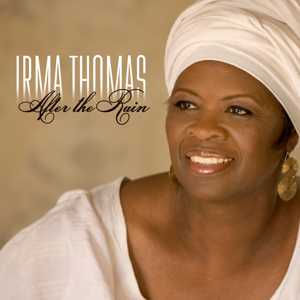
They’d booked Ultrasonic Studios, owned by Farrell and Steve Reynolds and the site of recordings by Fats Domino, Dr. John, and James Booker, for the recording of After the Rain. It was fall 2005.
Then came Katrina and the storm’s resulting floods.
At the time, Ms. Thomas and her husband were in Austin, Texas, for a performance. She was watching newscasts that showed the flooding under way in New Orleans. “I shook my husband, and told him, ‘I saw our house on TV, underwater,’” Ms. Thomas said.
Ultrasonic Studios was also mostly destroyed in the flood. Only the equipment and hard drives hastily stashed in the suspended ceiling survived, Billington said.
Ms. Thomas finally convened with the musicians a few months later to make After the Rain at Dockside Studio near Lafayette. One of her performances stands out in everyone’s memory: “In the Middle of It All,” one of Arthur Alexander’s straightforward, moving, less-heralded songs.
“When Irma and I chose that song initially, it wasn’t anything we thought would remotely have to do with the storm or the loss of the storm,” Billington said.
“She delivered this vocal that just devastated everybody. We all cried after that take,” he said. It was “a very heartfelt experience for all of us, and I think for Irma in particular.”
It was no wonder “when you think about what all of us in that studio had been through,” Ms. Thomas said. “Halfway through the song, I was already crying.”
She recalled that cell-phone service was so weak at Dockside that folks had to stand under a certain tree to get a signal.
Ms. Thomas and Billington won the Grammy Award for Best Contemporary Blues Album for After the Rain. Billington would also win for Best Traditional Blues Album for producing Bobby Rush’s Porcupine Meat in 2016. (Earlier, he produced an album for Clarence “Gatemouth” Brown that won a Grammy but producers didn’t receive the rewards then.)
Billington was also nominated for Grammy awards for My Dusty Road, a Woody Guthrie box set and for Best Historical Album last year for his part in Doc Watson: Life’s Work: A Retrospective.
Among her other albums, Billington and songwriting legend Dan Penn produced Ms. Thomas’ 2000 album, My Heart’s in Memphis: The Songs of Dan Penn, which included her version of the Penn-and Spooner Oldham-written classic, “I’m Your Puppet.” The record featured drummer James Robinson and others.
More music royalty
Zydeco singer Nathan Williams met Billington in 1987 when he was producing a Buckwheat Zydeco record.
Billington then saw Mr. Williams perform at Richard’s Zydeco Club, in Lawtell, Louisiana.
Since then, they’ve made eight albums together, including a children’s album with Johnette Downing (Scott’s spouse) this year. Nathan, Johnette and Scott are planning another record this year.
“Every time I play, I feel like I’m in heaven,” Mr. Williams said. “It’s just plain joy.”
“I might not be the best, but I have a lot of feeling,” he added.
Working with Mr. Williams has been an education for Billington. Zydeco is one of Louisiana’s signature sounds, of course, influenced by Caribbean rhythms, old French tunes, and rhythm and blues, and sometimes sung in Creole.
It’s “also some of the more joyous music on the planet,” Billington said.
Mr. Williams spoke Creole at home and remembered listening to zydeco with his friends standing on a washing machine and peering through the window of a nightclub called the Casino. Clifton Chenier, the great zydeco pioneer, was playing that night. Seeing the boys sneaking a look in the club, a woman began striking them with her purse. The boys had to return to the scene with police just to get their bikes, Mr. Williams said.
“My grandmother had loved (Clifton) Chenier and B.B. King,” he said. “Those were two records I had. My uncle played with Chenier.”
Celebrating 40 years of marriage back in April, Mr. Williams lives in Saint Martinville and Lafayette. He often plays music with his son and said he’s “blessed that I can express myself in music.”
“I never had a set list,” he said. If people want to hear a waltz, he added, then play them a waltz.
“I’m kind of like a gumbo.”
Billington also worked with the oft-overlooked, incredible New Orleans singer Johnny Adams.
“Johnny Adams played country, R&B, and jazz. His ear could take it all in,” said Billington, who collaborated with Adams on his 1984 “comeback” album, From the Heart. Adams and Billington would go on to record two “songbook” albums, highlighting the compositions of Percy Mayfield and Doc Pomus, enlisting musicians such as pianists John Cleary and Dr. John, and guitarists Duke Robillard and Walter Washington.
The singer himself prepared for the sessions, learning every nuance of melody and lyric. Once the groove was right, “Johnny Adams head for the vocal booth and start singing,” Billington recalled.
Billington calls Adams one of “greatest vocalists of the last century,” and at his best, Adams was killer. He burns through “This Time I’m Gone for Good,” for instance, a blues from the 1998 album Man of My Word, produced by Billington.
Adams also recorded a slew of country-soul songs for Shelby Singleton’s Nashville label SSS International in the late 1960s.

Chasing genius
New generations of listeners have been introduced to Ms. Thomas’ songs when they’ve occasionally appeared in TV shows or commercials. Licensing such songs can earn decent royalties for roots music artists.
“Anyone Who Knows” appeared in the TV series Black Mirror. “I got this beautiful check,” Ms. Thomas said. Another of her songs appeared in a cream cheese commercial.
Mr. Williams’ zydeco hit “Everything on the Hog” made it into one of NBC’s movies of the week, the singer said.
And “Zydeco Road,” written by Mr. Williams and Billington about a road in Plaisance, Louisiana, made it into a zombie movie. “It has a sixth chord, which is unusual for zydeco,” Billington said.
At the panel discussion in New Orleans, a young musician in the audience asked about the profoundly gifted New Orleans pianist James Booker, with whom Billington worked on the album Classified in 1982. Mr. Booker died in 1983. (Check out this documentary about Booker.)
“Booker was the greatest New Orleans pianist… His technique was mind blowing,” Billington said. “He just saw the world in a different way than most of us do.”
“James Booker was a genius. He didn’t understand himself,” Ms. Thomas said. “We were in Thibodaux, Louisiana, and I had never worked with him. He played every note just like it was on the record.”
Ms. Thomas keeps it real about her career and remains proud of her music.
“You get an opportunity to make people happy. I’ve got 60-plus years in business, a month ago,” she said. “I don’t know who my enemies are.”
MORE:
Irma Thomas’ interview and performance on NPR’s Weekend Edition
Ms. Thomas' wonderful album from last year with the New Orleans band Galactic


Seattle landscapes often have unique elevation and drainage considerations that should not be overlooked during construction. Structural Walls Services in Seattle, WA can provide functional support while contributing to the overall appearance of an outdoor space. Proper planning makes these structures both useful and visually integrated.
Rug damage does not always mean the entire rug needs to be replaced. Depending on the material and condition, professional repair may restore areas affected by wear or accidental damage. I found this information useful for people searching for rug repairs services in Scranton, PA because timely attention can help preserve both the appearance and usefulness of an existing rug.
Planning a group vacation independently can take a surprising amount of time because everyone may have different expectations. Professional assistance can help travelers compare options and keep the important details together. I think people searching for a group travel agency service near me could find value in having an experienced planner help coordinate the trip while allowing the group to focus on enjoying the experience.
Roofing repairs are much easier to manage when damage is discovered early. I appreciate articles that explain why routine inspections and timely maintenance matter for property owners. Anyone considering metal roof repair Tama, IA can use this information to better understand common concerns and repair planning.
I really enjoyed reading this article because it explains how proper installation and maintenance can extend the life of outdoor surfaces. Professional concrete services help homeowners create durable, attractive spaces that remain functional and visually appealing for many years.